
Colette and Nori in 2025.
Colette Fu is a Philadelphia-based artist who expands the language of the pop-up book through photography, paper engineering, sculpture, and large-scale installation. Moving between intimate books and immersive, kinetic works, she explores identity, cultural history, migration, and collective memory.
Fu received her MFA in Fine Art Photography from the Rochester Institute of Technology in 2003 and soon began combining photography with pop-up paper engineering. After living and teaching in Yunnan Province, China, she learned of her family’s Nuosu Yi heritage, an experience that led to years of travel and research and a 2008 Fulbright Research Fellowship exploring China’s ethnic minority communities.
Over the past two decades, Fu has continually expanded the scale and possibilities of the pop-up form. During a six-month residency at the Swatch Art Peace Hotel in Shanghai in 2014, she created I Love Shanghai, a monumental pop-up book measuring 2.5 × 5 × 1.7 meters. In 2017, she pushed the form further with Tao Hua Yuan Ji, a 13.8 × 21-foot walk-in pop-up book presented at TILT Institute for the Contemporary Image. In 2024, she created Noodle Mountain, a monumental, mechanically activated pop-up installation in which turning a crank causes an enormous tangle of noodles to rise from the landscape. Inspired by the children’s song “On Top of Spaghetti,” the work uses humor, movement, and spectacle to explore personal memories and complex intergenerational histories of place, labor, food, and diaspora.
Fu’s work is held in collections including the Metropolitan Museum of Art, the Library of Congress, the Getty Research Institute, the National Museum of Women in the Arts, and the Cooper Hewitt, Smithsonian Design Museum. Her awards include a Philadelphia Cultural Treasures Grant, Forman Arts Initiative Art Works Grant, Joan Mitchell Foundation Painters & Sculptors Grant, Meggendorfer Prize, and Fulbright Research Fellowship.
Fu has participated in artist residencies at the Swatch Art Peace Hotel, Yaddo, MacDowell, the Fine Arts Work Center in Provincetown, Sacatar, Vermont Studio Center, Bemis Center for Contemporary Arts, Visual Studies Workshop, Millay Colony, and Alden B. Dow Center for Creativity. Her work has been presented in solo exhibitions at institutions including the National Museum of Women in the Arts, Asian Arts Initiative, Taubman Museum of Art, Bainbridge Island Museum of Art, and the Athenaeum of Philadelphia.
Fu also teaches pop-up paper engineering internationally and leads community-based projects that use the pop-up form as a vehicle for storytelling and collective expression.
Her recent work brings this evolving sculptural language to questions of Chinese American history, immigration, labor, and community memory. Iron and Paper: Unfolding Philadelphia’s Chinatown, a large-scale, mechanically operated five-spread pop-up book, uses movement and the turning of pages to unfold the layered history of Philadelphia’s Chinatown—its immigration histories, struggles against exclusion and displacement, and the resilience of the community.
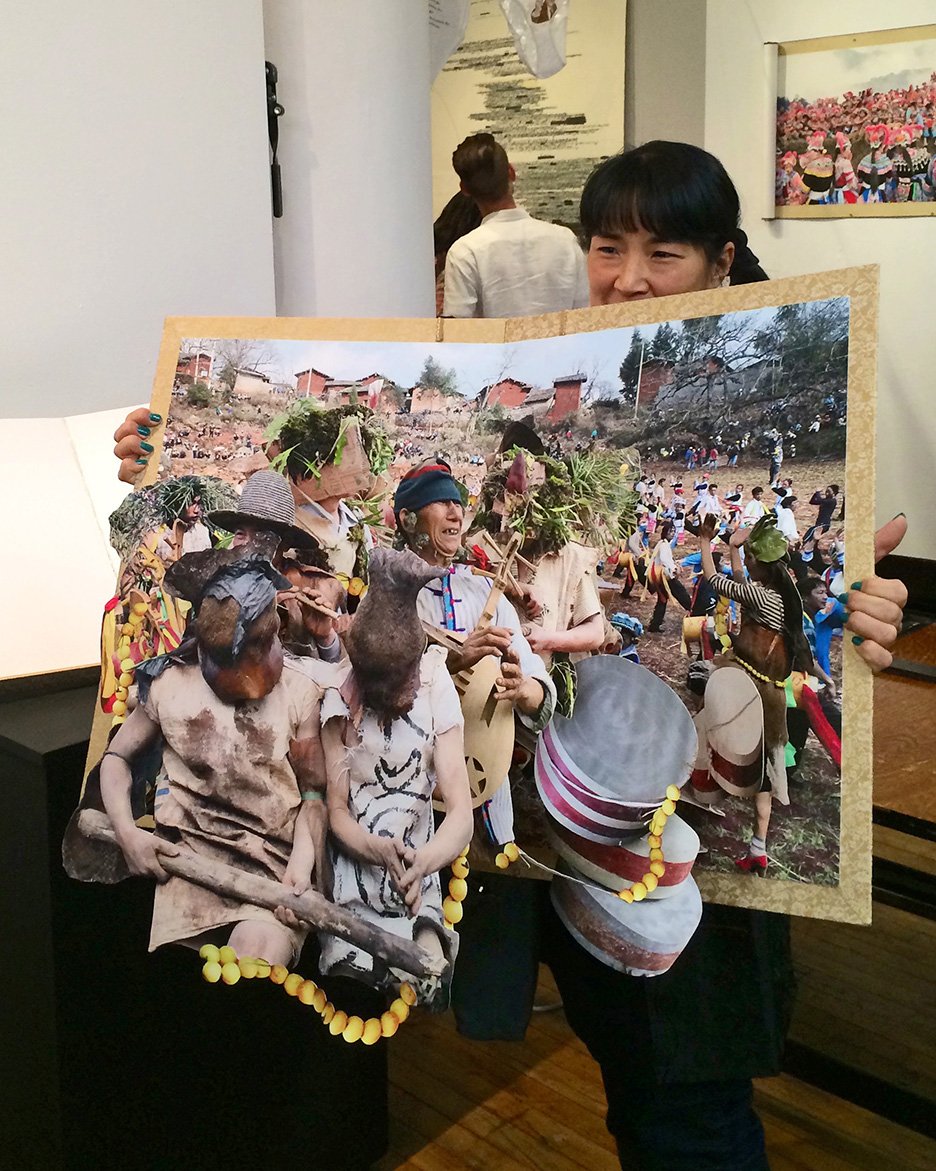
My work grew out of a personal search for identity and belonging. Growing up Chinese American, I often felt embarrassed by my heritage and wanted to distance myself from it. After college, I traveled to Yunnan Province, where my mother was born, and discovered my family’s Nuosu Yi heritage. The experience reshaped my understanding of what it means to be Chinese and eventually led me to use photography and pop-up books to explore cultures and histories that are often overlooked or misunderstood.
I use the mechanics of the pop-up book to give physical form to this process of discovery. A pop-up begins flat, but through movement, something concealed is revealed. For me, this unfolding reflects the layered nature of identity and history and reinforces the idea that what we see on the surface is never the whole story.
I am drawn to the trial and error, spatial reasoning, and problem-solving required to transform something flat into something dimensional and movable. There is a sense of control, accomplishment, and reward when the pieces finally work together and the structure springs to life. As my work has grown from intimate books into monumental pop-ups, walk-in environments, and kinetic installations, these puzzles have become increasingly complex.
Through humor, spectacle, and wonder, I invite viewers into histories of migration, labor, food, family, and community. By blurring boundaries between photography, books, craft, sculpture, and installation, I hope to create spaces for curiosity, discovery, and connection.
For me, unfolding is both a physical action and a way of understanding: something hidden becomes visible, something flat acquires space, and what first appears simple reveals its complexity.